
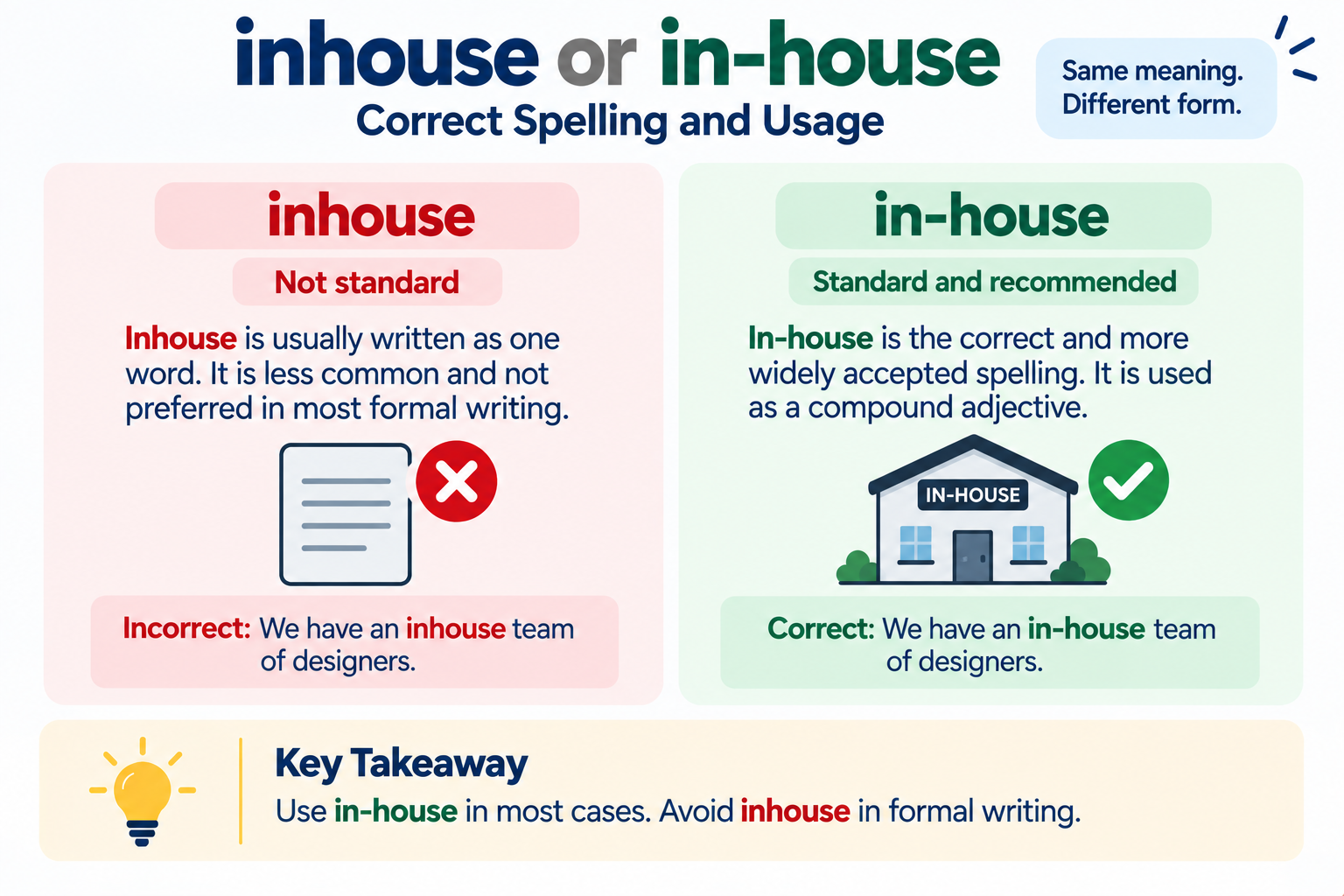
If you are unsure about inhouse or in-house, you are not alone. The correct standard form is in-house when the term describes something handled within a company, organization, or business instead of being given to an outside provider. The form inhouse is generally treated as a nonstandard spelling and should be avoided in polished writing.
The confusion happens because English often combines words over time. Some compounds become one word, some stay as two words, and others use a hyphen. This makes terms such as in-house easy to spell incorrectly, especially when they appear often in workplace writing. You may see the term in business emails, job descriptions, marketing material, legal writing, and everyday conversation.
This guide explains the spelling, meaning, grammar, pronunciation, and real world use of the expression. You will also see how in-house differs from the separate phrase in house, why inhouse causes confusion, and how to choose the right form quickly when you are editing a sentence.
Quick Answer
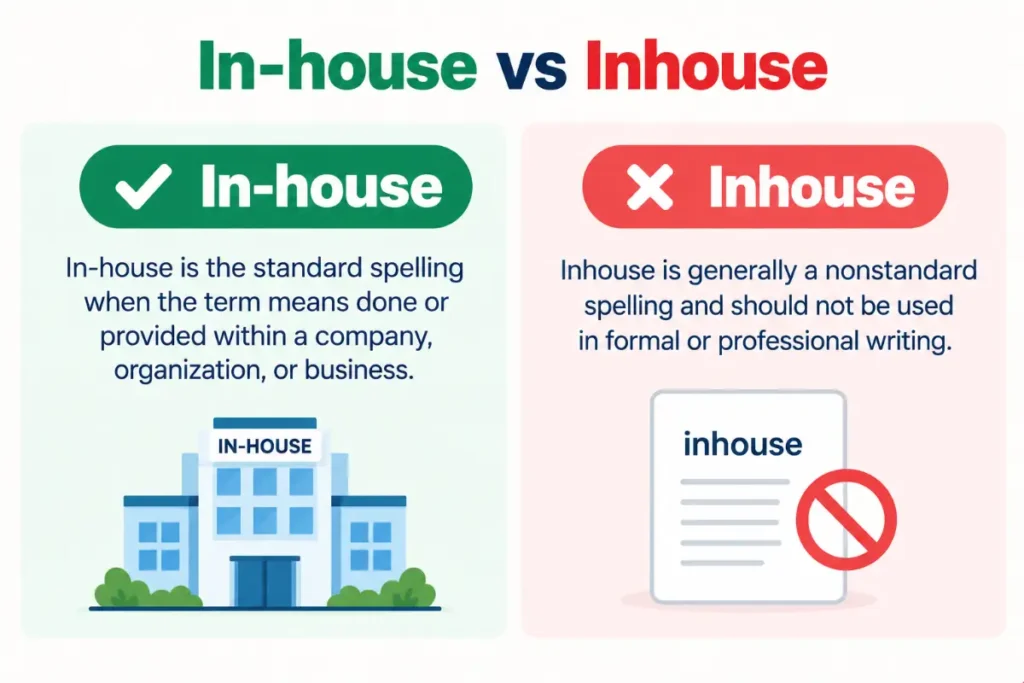
In-house is the standard spelling when the term means done or provided within a company, organization, or business. Inhouse is generally a nonstandard spelling and should not be used in formal or professional writing. The separate words in house can be correct when they function as an ordinary prepositional phrase with the literal meaning of being inside a house.
What the Term Means
The expression describes work, services, employees, resources, or activities that exist or happen within an organization rather than being handled by an outside person or company.
For example:
- The company has an in-house design team.
- We handle all technical support in-house.
- The university provides in-house training for new employees.
- The firm hired an in-house attorney.
In each example, the idea is internal rather than external.
An organization might normally hire a contractor, consultant, agency, freelancer, or other outside provider. If it performs the same work using its own staff or resources, that work can be described as in-house.
The term is common in business English, but it is not limited to business. Schools, hospitals, government agencies, sports organizations, publishers, law firms, and other institutions can all use it.
Is Inhouse a Correct Word
Inhouse is generally not the standard spelling for this meaning.
People often write it as one word because many English compounds have developed from separate words into closed compounds. Examples include words such as workplace, website, and online. That spelling pattern can make inhouse look natural, but it does not make it the standard form.
In edited American English, use in-house for the established compound.
For example:
Correct:
The company has an in-house marketing team.
Not standard:
The company has an inhouse marketing team.
The second version may appear online or in informal material, but frequent appearance does not make a spelling standard. Professional editors normally change it to in-house when it has the intended compound meaning.
The Correct Form
In-house is normally written with a hyphen when it functions as a compound adjective or adverb.
As an adjective, it describes a noun.
For example:
- We have an in-house lawyer.
- The company offers in-house training.
- She works on the in-house design team.
- The publisher has an in-house editor.
As an adverb, it tells you where or how an activity is performed.
For example:
- We produce the videos in-house.
- The company handles customer support in-house.
- They develop the software in-house.
- The restaurant makes its desserts in-house.
The meaning stays connected to the idea of internal work or resources.
In House Has a Different Use
The separate phrase in house can also be grammatically correct, but it usually has a different structure.
Consider this sentence:
The children played in the house.
Here, in is a preposition and the house is a noun phrase. The sentence literally says that the children played inside the house.
The same basic structure appears in sentences such as:
We stayed in the house during the storm.
This is not the business expression discussed in this article. It is simply the preposition in followed by the noun house.
The distinction becomes clearer when you compare these sentences:
The company provides in-house training.
The workers stayed in the house.
The first sentence describes training provided internally by the company. The second describes a physical location.
This difference is one of the most useful ways to remember the spelling.
Comparison Table
| Form | Meaning | Part of Speech | Standard Use | Formality | Common Context | Example |
|---|---|---|---|---|---|---|
| In-house | Done or provided within an organization | Adjective or adverb | Standard | Formal and informal | Business and professional writing | We provide in-house training. |
| Inhouse | Intended to express the same meaning as in-house | Nonstandard spelling | Avoid in edited writing | Informal or incorrect | Typing and casual online writing | Avoid this spelling in formal work. |
| In house | Inside a house or within a particular house | Prepositional phrase | Standard when the literal meaning applies | Formal and informal | Physical location | They stayed in the house. |
The key point is that these forms are not simply three interchangeable spellings. In-house serves as the established compound for internal work or services. In house has a normal grammatical role when house is being used as a noun.
Key Differences Explained
The difference becomes easier to understand when you look at several parts of English usage.
Spelling
The standard compound is in-house. The hyphen shows that the two words work together as one descriptive unit.
Inhouse removes the hyphen and creates a closed compound that is not the standard form for this meaning.
Meaning
In-house usually means internal to an organization.
For example:
The company has an in-house photographer.
This means the photographer works within the company rather than being an outside service provider.
In house can describe physical location.
For example:
The guests ate in the house.
Here, house refers to a physical building.
Grammar
In-house can work as an adjective or adverb.
As an adjective:
She joined the in-house legal team.
As an adverb:
We manage the project in-house.
In house usually functions as a prepositional phrase when it has the literal location meaning.
Pronunciation
The pronunciation is essentially the same for the compound expression and the separate phrase. The spelling difference is therefore much easier to notice in writing than in speech.
Formality
In-house is suitable for professional writing, academic contexts, workplace communication, and everyday English.
Inhouse should be avoided in polished writing because it is not the established standard spelling.
Context
The compound appears often in business and professional contexts.
Common examples include:
- In-house counsel.
- In-house training.
- In-house marketing.
- In-house development.
- In-house production.
- In-house support.
- In-house design.
- In-house staff.
Which Form Is Correct
The correct form for the meaning of internal work or services is in-house.
The hyphen helps show that the two elements form a compound expression. English uses hyphens in many compound modifiers to make their relationship clear.
For example:
The company hired an in-house accountant.
Here, in-house modifies accountant. It tells the reader what kind of accountant the company hired.
The same idea applies to:
an in-house consultant
an in-house writer
an in-house training program
an in-house research team
Writing inhouse as one word is not the standard choice for these examples.
When to Use In-House as an Adjective
Use the compound as an adjective when it comes directly before a noun and describes something that belongs to or operates within an organization.
For example:
We have an in-house design team.
The term modifies design team.
Other examples include:
The company launched an in-house publication.
She works with the in-house legal department.
They created an in-house training program.
The hospital has an in-house pharmacy.
The same pattern works across many industries.
Common Adjective Patterns
Several combinations are especially common:
- In-house team.
- In-house staff.
- In-house expert.
- In-house counsel.
- In-house training.
- In-house service.
- In-house department.
- In-house solution.
The exact noun can change, but the meaning remains focused on internal resources.
When to Use In-House as an Adverb
The expression can also describe an action that happens internally.
For example:
We develop our software in-house.
Here, in-house modifies the verb develop by explaining where or by whom the work is done.
Other examples include:
The company prints its brochures in-house.
We handle payroll in-house.
They produce all their videos in-house.
The team manages customer support in-house.
In these sentences, there is no noun immediately after the expression. It still keeps the same basic meaning of internal production or management.
Ten Natural Sentence Examples
Here are ten examples that show how the standard form works in different settings.
- Our company has an in-house marketing team that handles most campaigns.
- The school provides in-house training for teachers throughout the year.
- We decided to keep the project in-house instead of hiring an outside agency.
- The law firm has several in-house attorneys who work directly with its clients.
- She joined the company as an in-house editor after working as a freelancer.
- The manufacturer performs most of its quality testing in-house.
- Our IT department develops and maintains the software in-house.
- The university offers in-house workshops for staff members.
- The restaurant makes many of its sauces in-house.
- The publisher hired an in-house proofreader to review the final manuscript.
These examples show two major patterns. The first uses the compound before a noun, while the second uses it after a verb to describe internal work.
Common Mistakes
Writing Inhouse as One Word
Incorrect:
We have an inhouse design team.
Correct:
We have an in-house design team.
The one word form often appears because writers naturally shorten familiar compounds. In edited English, keep the hyphen.
Using In House for the Business Meaning
A writer may produce:
The company handles its accounting in house.
For this established business meaning, in-house is the safer standard form in polished writing.
Correct:
The company handles its accounting in-house.
The separate form can still be correct when house has its literal noun meaning.
Confusing Meaning With Location
Consider:
The employees stayed in the house.
This refers to a physical building.
Compare it with:
The company handles the work in-house.
This refers to internal company resources.
The words look similar, but the grammatical structure and meaning are different.
Treating Inhouse as an Accepted Variant
Some writers assume that common online usage makes inhouse an accepted spelling. Frequency alone is not enough to establish a standard form.
If you are writing an email, report, article, resume, academic paper, or business document, use in-house for the internal business meaning.
Removing the Hyphen in Compound Modifiers
Writers sometimes remove hyphens from compound expressions because the meaning still seems obvious.
Compare:
in-house editor
with:
inhouse editor
The first form follows the established spelling pattern. The second is not the standard choice.
Pronunciation Guide
The standard expression is pronounced approximately like:
in house
A simple pronunciation guide is:
in hous
The stress falls naturally on house, especially in normal speech.
The International Phonetic Alphabet pronunciation may be represented approximately as /ˌɪn ˈhaʊs/.
The first part sounds like the word in. The second part sounds like house.
Because the spoken form is so close to the ordinary phrase in house, spelling mistakes are easy to make. Someone can know the expression perfectly well in conversation and still type it incorrectly.
The main issue is therefore not pronunciation. It is recognizing the grammatical function of the expression in writing.
Etymology and Word Origin
The expression is built from two ordinary English words, in and house. Both have long histories in English and related Germanic languages.
The word house comes from Old English hūs, meaning a dwelling or home. It is related to similar words found in other Germanic languages.
The preposition in also has deep Germanic roots and has long expressed the idea of being inside a place or within something.
The modern compound meaning developed naturally from the basic idea of work being done inside an organization or establishment. In professional English, the term came to be used for services and activities handled by an organization’s own employees or resources.
The hyphen helps signal that the expression functions as a compound rather than as an ordinary physical location phrase.
Regional Usage
American English
In-house is standard American English for work or services handled internally by an organization.
It is common in business, law, education, technology, publishing, healthcare, manufacturing, and many other fields.
Examples include:
in-house counsel
in-house training
in-house development
in-house marketing
American writers should generally use the hyphenated form in professional documents.
British English
British English also commonly uses in-house for this meaning. There is no major spelling difference between American and British English here.
You may encounter minor differences in individual style guides, but the standard compound form remains familiar in both varieties.
Canadian English
Canadian English also uses in-house in professional and organizational contexts. There is no major Canadian spelling difference that changes the basic rule.
Australian English
Australian English also uses the established compound in-house for internal services and activities.
The term is widely understood across major varieties of English, so this is not a case where American and British spelling rules produce different standard forms.
Grammar Rules
Understanding the grammatical role makes the spelling much easier to remember.
Before a Noun
Use in-house when the expression works as a compound adjective before a noun.
For example:
We hired an in-house designer.
The expression describes the designer.
Another example is:
The company offers in-house training.
The expression describes the type of training.
After a Verb
The expression can also appear after a verb.
For example:
We handle the work in-house.
Here, the expression describes how or where the company handles the work.
Another example:
They produce the material in-house.
The meaning is that they produce it internally.
Literal Location
Use the separate words in house when house is a noun referring to a physical dwelling and the grammatical structure calls for that phrase.
For example:
The family stayed in the house during the storm.
Here, the phrase has nothing to do with internal company services.
This distinction is useful because it prevents you from treating every appearance of the words as the same grammatical construction.
In House Versus In-House
The easiest way to choose between the forms is to ask what house means in the sentence.
If you mean a physical house, the separate words may be correct.
The children were playing in the house.
If you mean something is handled internally by an organization, use the compound.
The company handles the project in-house.
The second sentence does not mean the project takes place inside a building. It means the organization handles it using its own people or resources.
This simple meaning test works in most everyday cases.
Real Life Usage
Daily Conversation
The term appears in ordinary conversations about work and services.
For example:
We do all our repairs in-house.
My company has an in-house photographer.
These sentences sound natural in workplace conversations and casual discussions about business.
Workplace Communication
Professional communication frequently uses the expression.
For example:
Our in-house team will review the proposal before Friday.
We provide in-house support for all major accounts.
The term is useful because it communicates the difference between internal work and outsourced work in just two words.
Academic Writing
Academic institutions can also use the term.
For example:
The university provides in-house training for new faculty members.
The research center has an in-house editing team.
The expression is clear and suitable for formal writing.
News and Journalism
News writing can use the term when discussing organizations, businesses, or professional services.
For example:
The company plans to expand its in-house production team.
The organization created an in-house unit to manage communications.
The term can efficiently describe organizational structure without extra explanation.
Literature and Storytelling
The expression is less common in literary storytelling, but it can still appear when the subject involves business, institutions, or professional life.
For example:
The magazine relied on its in-house editor to prepare the final issue.
Their in-house chef created the menu for the event.
The usage remains straightforward because the meaning depends on internal responsibility.
Related and Confused Terms
Several expressions are closely connected to this term.
Internal
Internal means existing or operating within an organization or system.
The company conducted an internal review.
It is often a good alternative when you want a more formal word.
Outsourced
Outsourced describes work given to an outside company or person.
The company outsourced its customer support.
This is often the opposite of handling work internally.
External
External refers to something outside an organization or system.
The company hired an external consultant.
Staff
Staff refers to the people who work for an organization.
Our staff handles customer support.
An internal team may be part of the staff.
Internal Team
Internal team is a clear alternative to the compound expression.
Our internal team will complete the project.
This can be useful when you want to avoid a compound modifier.
Outsourcing
Outsourcing is the practice of obtaining work or services from an outside provider.
The company reduced costs by outsourcing payroll.
This creates a clear contrast with internal work.
In Company
In company has different uses and should not be treated as a direct synonym. Depending on context, it can refer to being with other people or within a company setting.
On Site
On site or onsite describes something located at a particular place. It is related to workplace language but does not have the same meaning as in-house.
For example:
An onsite technician repaired the equipment.
That describes location. An in-house technician describes employment or organizational affiliation.
In-House and Outsourcing
One of the most common contexts for this expression is the contrast between internal work and outsourcing.
Suppose a company needs a new website. It has two broad choices. It can ask its own employees to build the website, or it can hire an outside agency.
If its own employees build it, the company may describe the work as in-house.
If an outside agency performs the work, the company has outsourced it.
For example:
We developed the website in-house.
This tells the reader that the company handled the work internally.
Compare:
We outsourced the website development.
This tells the reader that an outside provider handled the work.
The terms can therefore help explain how organizations divide responsibilities.
Why the Spelling Causes Confusion
The confusion has a simple linguistic explanation.
English contains many compounds that have changed spelling over time. Some began as separate words and later became hyphenated or closed compounds. Readers often apply the pattern from one familiar word to another.
For example, a writer may know workplace and website as closed compounds and assume that inhouse should work in the same way.
That assumption is understandable, but English spelling does not always follow a single predictable pattern. Established usage matters.
Pronunciation adds another layer of confusion. The spoken expression does not clearly tell you if the written form should contain a space, a hyphen, or no space.
The best solution is to remember the specific compound rather than trying to predict its spelling from sound.
A Simple Memory Trick
Use this rule:
Internal work gets a hyphen. A physical house can use separate words.
Think about the meaning before you type.
If you mean:
handled by the company itself
write:
in-house
If you mean:
inside the physical house
use the ordinary grammatical phrase:
in the house
This memory trick works because it connects spelling to meaning instead of asking you to memorize a spelling without context.
Expert Editor Insight
An experienced editor usually checks the function of the phrase before changing its spelling. If it describes an internal company service, team, or activity, in-house is the standard polished choice. If the words refer to a physical house, the editor looks at the surrounding grammar and keeps the ordinary phrase intact. Spelling and grammar tools may flag inhouse because it does not match the established compound form, but context still matters. A good editor does not simply replace every occurrence without checking what the sentence means.
Common Workplace Expressions
You will often see the standard compound in phrases such as:
- In-house team.
- In-house counsel.
- In-house attorney.
- In-house designer.
- In-house developer.
- In-house writer.
- In-house editor.
- In-house training.
- In-house support.
- In-house production.
- In-house marketing.
- In-house research.
These combinations are useful because they describe resources that an organization manages internally.
For example:
The company hired an in-house developer.
The developer is part of the organization’s internal operation.
Compare that with:
The company hired a freelance developer.
The second sentence points to an outside worker rather than an internal employee.
Is the Hyphen Always Necessary
For the established compound meaning, the hyphen is the safest standard choice in polished American English.
This is especially useful when the expression appears before a noun:
an in-house team
an in-house lawyer
an in-house training program
The hyphen makes the compound relationship clear.
When the expression appears after a verb, you may encounter style variation in some publications. Still, in-house remains a clear and widely accepted form for professional writing.
Consistency matters most. If you are preparing a report, website, article, company document, or other edited material, choose one established style and apply it consistently.
Can You Start a Sentence With In-House
Yes. The expression can appear at the beginning of a sentence when the grammar supports it.
For example:
In-house teams often have a deeper understanding of company procedures.
Here, the expression acts as part of the sentence structure and does not need to be avoided simply because it appears first.
Another example is:
In-house training can reduce the need for outside instruction.
There is no grammatical rule that prevents the compound from starting a sentence.
Is It Appropriate in Formal Writing
Yes. In-house is appropriate in formal writing when the meaning is relevant.
You can use it in:
- Business reports.
- Academic documents.
- Workplace emails.
- Company policies.
- Professional articles.
- Legal and organizational writing.
- Job descriptions.
- Training documents.
For highly formal writing, you can also use alternatives such as internal, within the organization, or provided internally when they fit the sentence better.
For example:
The company conducted an internal review.
This may sound more formal than:
The company conducted an in-house review.
Both can be correct, but the best choice depends on tone and context.
Editing Tips for Professional Writers
If you regularly write workplace or business content, use these simple checks.
- Look at the meaning first. Ask if the expression means internal work or a physical location.
- Use in-house for the established compound meaning.
- Do not create inhouse simply because other English compounds are written as one word.
- Check the surrounding grammar before changing in house.
- Keep your spelling consistent throughout the same document.
- Read the sentence aloud after editing. The spoken sound will not reveal the spelling, but it can help you focus on the meaning and sentence structure.
- If a style guide for your organization gives a specific rule, follow that guide consistently.
Conclusion
The answer to inhouse or in-house is straightforward: use in-house when you mean something handled or provided within an organization. The closed form inhouse is generally not the standard spelling, so it is best avoided in professional and formal writing.
Remember that in house can still be correct when the words have their ordinary grammatical meaning and refer to a physical house. The difference is based on meaning and sentence structure, not just spelling.
The easiest editing rule is simple: internal company work takes in-house. A physical location can use the ordinary words in the house. Once you connect the spelling to the meaning, the distinction becomes much easier to remember and apply consistently
FAQs
Is inhouse a real English word?
Inhouse can be found in informal writing and online text, but it is generally not the standard spelling for the established expression meaning internal to an organization. In professional and edited American English, use in-house instead. If you are writing a report, article, resume, email, or business document, the hyphenated form is the safer standard choice.
What does in-house mean?
In-house means handled, provided, produced, or managed within an organization rather than by an outside provider. For example, an in-house designer works within the organization, while an outside design agency provides an external service. The expression is common in business, education, law, technology, publishing, healthcare, and many other professional settings.
Which is correct inhouse or in-house?
In-house is the standard form for the meaning of internal work or services. Inhouse is generally treated as a nonstandard spelling. The separate words in house can still be correct when they form an ordinary phrase referring to being inside a physical house. The surrounding meaning and grammar determine the correct construction.
How do you pronounce in-house?
In-house is pronounced like the ordinary words in house. A simple pronunciation guide is in hous, with the main stress on house. The approximate IPA form is /ˌɪn ˈhaʊs/. Because the spoken form does not reveal the written spelling, people can easily use the wrong form when typing the expression.
Can in-house start a sentence?
Yes. In-house can start a sentence when it fits the grammar. For example, you can write, In-house teams often understand company procedures well. Starting a sentence with the expression does not create a grammar problem. The same spelling rule applies at the beginning, middle, or end of a sentence.
What is a synonym for in-house?
Useful alternatives include internal, within the organization, provided internally, and handled internally. The best choice depends on the sentence. For example, internal training can replace in-house training, while handled internally can replace managed in-house. These alternatives can make formal writing sound more direct when the compound is not necessary.
Why do people spell in-house as one word?
People often write inhouse because English contains many closed compounds that are written as one word. Pronunciation also gives no clear clue about the hyphen. Writers may therefore assume that the expression should follow the same pattern. Established usage, however, favors in-house for the standard compound meaning.
Is in-house suitable for formal writing?
Yes. In-house is suitable for professional and formal writing when you need to describe work, services, teams, or resources handled within an organization. It appears naturally in business documents, reports, academic contexts, workplace communication, and professional writing. Avoid the nonstandard closed spelling inhouse in polished documents.
